What's on the report
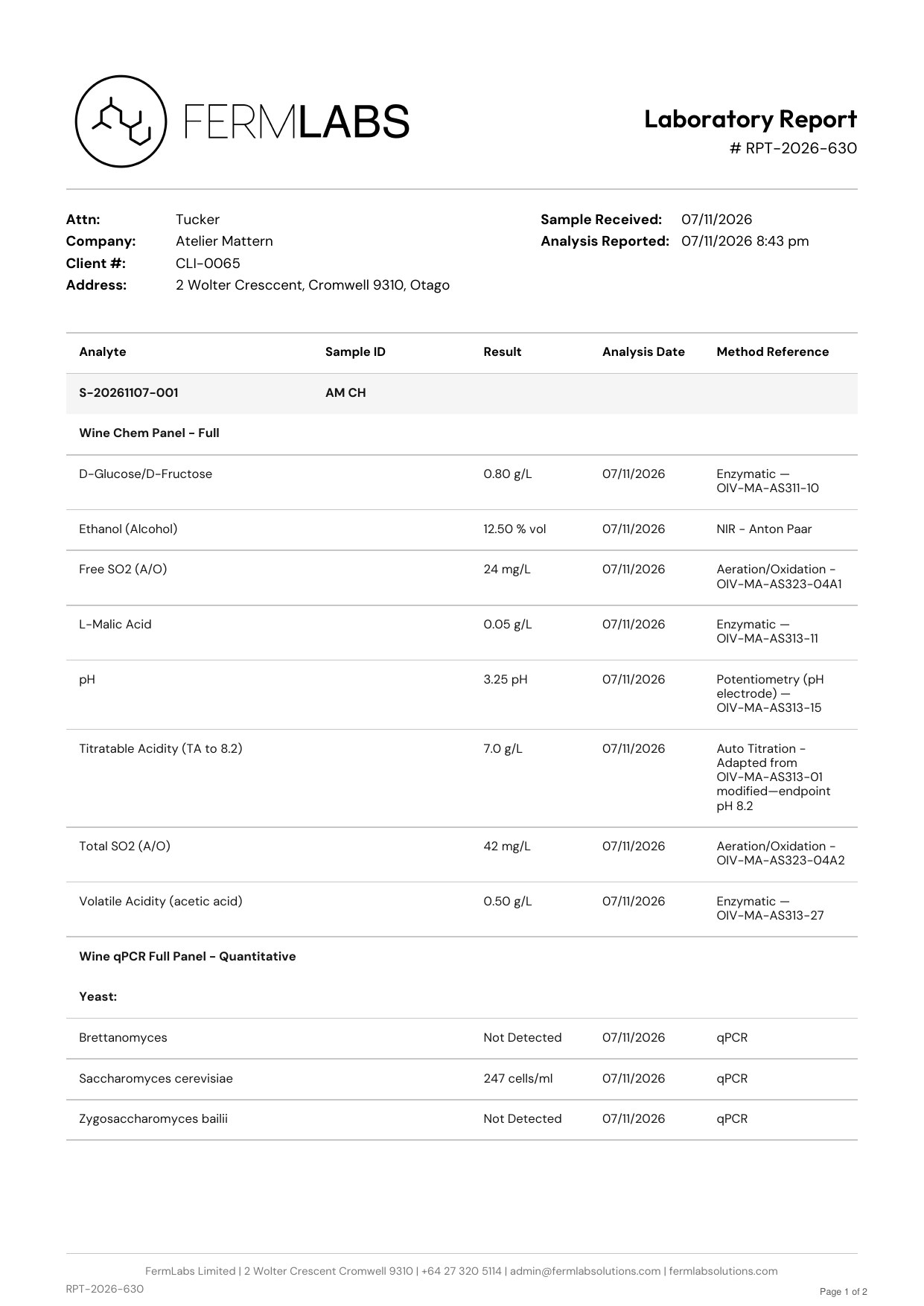
- Report number — top right (RPT-…). Quote it if you call us.
- Your details and dates — who it's for, when we received the sample and when the results were reported.
- Sample ID and your code — our sample ID (S-…) alongside the code you gave the sample in the request portal, so results line up with your cellar records.
- Panel, analyte and result — grouped by the panel or test you requested, one line per analyte with its unit and analysis date.
- Method reference — the method used for each result, with the OIV reference method where one applies.
- qPCR results — cells/mL for each organism, Not Detected, or Trace (detected below the ~10 cells/mL quantification limit). The qPCR guide covers what each level means.
Every report stays in the request portal, so you can see how a wine's numbers have moved over time.
Units
| Unit | Used for |
|---|---|
| g/L | TA (as tartaric), VA (as acetic), malic, citric, sugars |
| mg/L | Free and total SO₂, potassium |
| mg N/L | YAN — the nitrogen content, not the mass of the compounds |
| % v/v | Alcohol |
| °Brix · SG | Sugar in juice; density during and after ferment |
| cells/mL | qPCR microbiology |
Typical ranges for finished dry table wine
These are broad, typical ranges — styles, varieties and seasons vary. Use them to spot what deserves a second look.
| Analysis | Typical | Look closer if | Guide |
|---|---|---|---|
| pH | 3.2–3.7 | Above 3.7: SO₂ works less well, microbial risk rises | SO₂ |
| TA | 5–8 g/L | Out of balance with pH or style | |
| Free SO₂ | Depends on pH | Molecular below about 0.5 (reds) or 0.8 (whites) | SO₂ |
| VA | Below 0.6 g/L | Above 0.6, or rising between tests | VA |
| Glucose + fructose | Below 2 g/L | Above 2 g/L in a wine meant to be dry | |
| L-malic (after MLF) | Below 0.1–0.2 g/L | Above 0.3 g/L in a wine meant to have finished MLF | Malic |
When a number surprises you
- Check the sample. Was it taken from the right vessel, after mixing, in a clean full container? Was it sampled before or after an addition?
- Compare with history. One odd point in a steady series often points to sampling, not the wine.
- Call or email us. We'll check the run and re-test if needed — questions about results are part of the service.
Not sure what to test next?
Which test do I need?FermLabs guide · general information only — your own wine's analysis and trials come first.